

Can Moroccan Cuisine Write Its Own Future?
A reflection by Chef Faïçal Zahraoui on terroir, transmission, and the modernity of Moroccan cuisine.
As a Moroccan chef, I find myself pondering several fundamental questions today. Is Moroccan terroir set in stone? Can our culinary identity be defined solely by the recipes handed down by previous generations? What happens to our cuisine when the seasons shift, when years of drought transform agricultural landscapes, and when new products sustainably take root on our land?
Must a recipe have existed for generations to be rightfully considered Moroccan? If I introduce an ingredient absent from our traditional repertoire, does my creation become foreign to our culinary heritage? Or can we forge a new Moroccan culinary canon—one capable of evolving with its era without forsaking its soul?
These inquiries lie at the very core of my culinary journey.
A Living, Shifting Moroccan Terroir
I do not regard terroir as a static relic preserved in amber. It evolves in concert with climate, water availability, seasonal cadences, agricultural practices, and the relentless dedication of local producers.
Across the years, certain crops fade, others re-emerge, and innovative produce claims its rightful place across the Moroccan landscape. Ingredients once scarce or peripheral are now cultivated, harvested, and embraced on a consistent scale.
The carob tree stands as an eloquent testament. Perfectly attuned to the Mediterranean climate and water scarcity, it is an integral pillar of our natural heritage. Morocco harvests and exports vast quantities of carob, yet this noble ingredient remains largely unexplored in our contemporary gastronomy.
Our coastlines similarly harbor bountiful reserves of red algae, notably Gelidium, prized in the craftsmanship of agar-agar. This marine treasure already fuels prestigious global supply chains, yet remains virtually uncharted within our domestic culinary imagination.
I am equally fascinated by the burgeoning cultivation of specialty mushrooms across multiple regions. Several varieties offer exquisite textures, exceptional nutritional profiles, and protein richness that unlock compelling frontiers for a more plant-forward cuisine.
To this, one must add indigenous wild herbs, aromatic flora, and select subtropical fruits that now flourish across Morocco with newfound abundance and regularity.
All these ingredients now belong to the agricultural, maritime, and human fabric of our nation. Why should our contemporary gastronomy turn a blind eye simply because they were not recorded in ancestral manuscripts?
What Truly Makes a Recipe Moroccan?
I firmly believe that a cuisine cannot be reduced to a restrictive inventory of permitted ingredients. It reveals itself in how flavor is architected—in the nuanced mastery of spices, the delicate tension between acidity and sweetness, the slow alchemy of fire, fermentation, preservation, and the sacred ritual of communal sharing.
Countless dishes we revere today as quintessential hallmarks of Moroccan identity are themselves the fruits of cross-cultural exchanges, migrations, and successive adaptations over centuries. Ingredients journeyed across continents, customs evolved, and recipes transformed as they encountered diverse regions, families, and eras.
Tradition was never motionless; it is the beating heart of a living transmission.
The question I pose is therefore never simply whether an ingredient is ancient or new. Rather, I seek to understand how it anchors itself into our soil. Where is it grown? How long has it been cultivated? How have local growers embraced it? In what manner can it engage in authentic dialogue with the tastes, gestures, and harmonious balances of Moroccan gastronomy?
Can I craft an authentically Moroccan dish incorporating carob, marine red algae, locally cultivated mushrooms, or an acclimatized fruit? I wholeheartedly believe so—provided that I can articulate the lineage of that creation, its guiding intent, and its intimate kinship with our land.
Without that lineage, novelty is merely superficial spectacle. With it, creation becomes meaningful continuity.
Understanding Before Creating
My mission is neither to replicate ancient recipes verbatim nor to sever ties with the past. I endeavor to dissect the foundational mechanisms that built them, so as to envision the next chapter.
Every creation may take inspiration from a single product, a specific region, an ancestral gesture, a preservation technique, a memory, or a treasured family recipe. I then examine its quintessential balances: what must be revered, what can gracefully evolve, and what grants the dish its distinctive soul.
Contemporary culinary technique intervenes solely when it serves to elevate pure flavor. It can calibrate a cooking temperature to perfection, unveil a subtle texture, lighten a preparation, or celebrate an exceptional ingredient. It must never devolve into an ostentatious display that eclipses the origins of the plate.
This discipline demands profound research, but above all, deep listening. It requires walking the fields with farmers, conversing with traditional cooks, master artisans, and bearers of ancestral wisdom. It requires documenting gestures, idioms, seasons, and heritage before putting knife to board.
I do not place myself above this inheritance; I simply aspire to be one of its faithful interpreters.
A Contemporary Moroccan Cuisine, Not a Fusion Cuisine
My cooking is occasionally labeled as fusion cuisine. Yet that terminology does not reflect my ethos.
Fusion cuisine generally relies on the deliberate collision of disparate culinary traditions, juxtaposing techniques, flavors, and references borrowed from divergent cultures to synthesize a composite lexicon.
My culinary universe originates wholly from Morocco. It is rooted in its terroir, its memory, its people, and its ancestral customs. The modern techniques I employ are merely tools in service of expression; they do not dictate the identity of the dish.
Employing a modern technique does not turn a recipe into fusion. Reinterpreting the presentation of a Moroccan ingredient does not strip it of its origins.
My ambition is neither to Westernize Moroccan gastronomy nor to dilute it for foreign approval. I want to demonstrate that it inherently possesses the depth, complexity, and sovereign resources to forge its very own modernity.
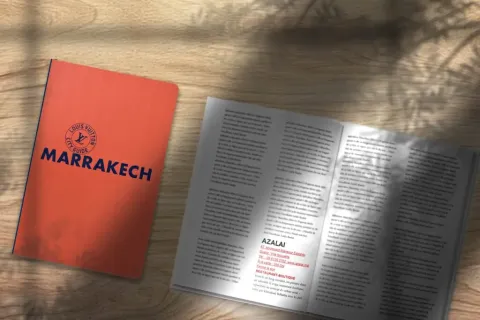
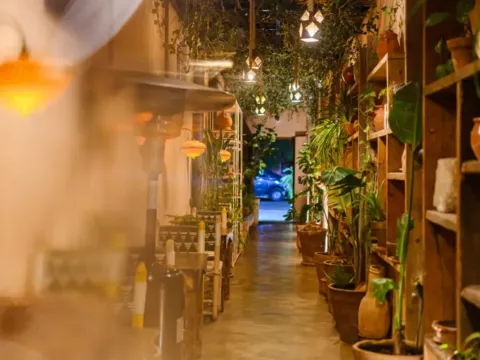
Azalaï Urban Souk, in Marrakech’s Guéliz district, is one of the vibrant spaces where this philosophy takes tactile form. Our menu is not the final destination of my journey; it is the visible dawn of a broader quest into the evolution of Moroccan culinary art.
Can We Build a New Moroccan Culinary Canon?
I often contemplate whether it is possible to pen a new compendium of Moroccan cuisine.
Not to supplant ancestral culinary texts, nor to presumptuously decree what is Moroccan and what is not, but rather to chronicle the living metamorphosis of our territory, the emergence of forgotten and new ingredients, and the inventive ways cooks, families, artisans, and producers embrace them today.
This canon would unite iconic heritage dishes with overlooked botanical treasures, inherited family recipes with avant-garde interpretations, ancient culinary gestures with their contemporary prolongations.
For every recipe, I want to clearly elucidate its point of departure, its provenance, the integrity of the product used, the primordial gesture it preserves, and why it remains intrinsically tethered to Moroccan culture.
This work could take the form of an exploratory recipe book, a research journal, an agricultural atlas, and a vessel of intergenerational transmission.
An Upcoming Book Dedicated to a Living Heritage
The book I am currently crafting is born of this aspiration. It will explore Moroccan terroirs, native products, ancestral gestures, cultural memories, and the dynamic transformations that keep our cuisine vibrant.
It will not be a pedestrian anthology of recipes or a cosmetic restyling of popular classics. My goal is to grasp the foundational pillars of Moroccan gastronomy in their full depth: earth, water, fire, time, conservation, hospitality, and transmission.
Contemporary creations must always remain anchored to an identifiable root. Rigorous inquiry will never serve as mere ornament after the fact; it must form the very cornerstone of creation.
This book will also shed overdue light on indigenous Moroccan ingredients that remain largely omitted from culinary literature, despite their vibrant reality across our nation today.
Evolving Without Erasing
How do we champion our heritage without imprisoning it? How do we preserve essential culinary wisdom while allowing vibrant new recipes to emerge? How do we transmit a living culture without reducing it to a handful of predictable clichés?
For me, protecting Moroccan gastronomy does not mean locking it away behind glass. It means knowing its bedrock, honoring its origins, and understanding the history that shaped its palate.
Yet it also means acknowledging that our world is transforming.
Seasons change. Crops adapt. New ingredients emerge. My responsibility as a chef is to observe them with humility, understand their potential, and integrate them with conscience.
I do not believe Moroccan cuisine needs to become a fusion cuisine to move forward. It can generate its own modernity from its history, its soil, and the passionate creativity of those who bring it to life every day.
My life’s work is to listen intently to what has been passed down, to witness what Morocco brings forth today, and to imagine the recipes that will tomorrow proudly take their place in the enduring tapestry of Moroccan gastronomy.